Point-elastic (P)
The surface gives only close to where the force lands. Sheet vinyl, rubber or poured polyurethane on a foam layer usually behaves this way.
Sports flooring guide
EN 14904 is the European specification for indoor multi-sport floors. Flooring brochures and data sheets often quote it, usually next to a CE mark. This guide explains what the standard measures, what a CE mark and a Declaration of Performance prove, what applies in Singapore and what to ask before you buy a floor or repaint its lines.
EN 14904:2006 is the European specification called “Surfaces for sports areas – Indoor surfaces for multi-sports use”. The European standards body CEN wrote it, and each member country publishes the same text under its own prefix, such as BS EN 14904 in the United Kingdom and DIN EN 14904 in Germany.
It covers halls where several sports share one floor. The examples it gives are handball, basketball, volleyball and five-a-side football, along with physical education. Indoor tennis halls are outside its scope.
The standard treats the floor as a system, which means the playing surface together with the layers that support it. Sport England's design guidance notes that thin sheet products laid straight onto a solid base are likely to fall outside its limits, although they can still suit a single sport.
Before 2006 each country had its own rules, such as BS 7044 Part 4 in the UK and DIN 18032 Part 2 in Germany. Brochures still quote the German standard beside EN 14904, so check which standard, edition and year a document names.
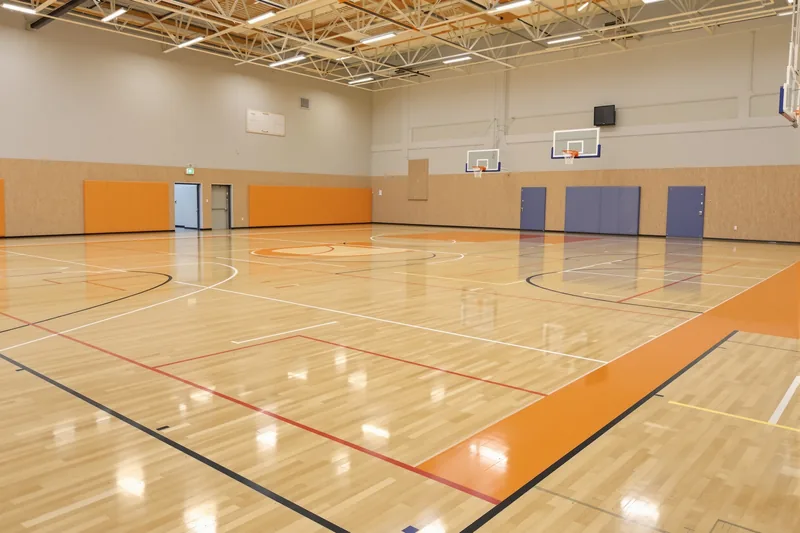
The requirements fall into two groups. The first is safety in use: friction, shock absorption and vertical deformation. The second is technical performance: ball bounce, rolling loads, wear, fire, emissions, gloss, indentation, impact and evenness. Each property has a named test method and a limit.
| Property | Test method | Requirement in EN 14904:2006 | What it tells you |
|---|---|---|---|
| Friction | EN 13036-4 (pendulum) | Mean pendulum value between 80 and 110 | Enough grip to stop slips, not so much that the foot sticks when turning |
| Shock absorption (force reduction) | EN 14808 | Between 25% and 75% | How much of a landing the floor absorbs compared with concrete |
| Vertical deformation | EN 14809 | Not more than 5.0 mm | How far the surface gives under load |
| Vertical ball behaviour | EN 12235, with a basketball | At least 90% of the rebound height on concrete | Whether the ball bounces truly |
| Resistance to a rolling load | EN 1569 | 1,500 N load, indentation not more than 0.5 mm, no damage | Whether backstops, trolleys and seating can be moved across it |
| Resistance to wear | EN ISO 5470-1 (Taber abrader) | Synthetic surfaces: not more than 1,000 mg lost per 1,000 cycles. Coatings and lacquers: not more than 80 mg per 1,000 cycles | How fast the surface or its lacquer wears away |
| Specular gloss | EN ISO 2813, at 85° | Not more than 30% for matt surfaces, 45% for lacquered surfaces | Glare from lights and windows |
| Resistance to indentation | EN 1516 | Residual indentation not more than 0.5 mm after 24 hours | Marks left by standing loads |
| Resistance to impact | EN 1517 | No cracking, splitting or delamination. On wood, indentation not more than 0.5 mm | Damage from dropped equipment |
| Degree of evenness | EN 13036-7 (straightedge), on site | Gap not more than 6 mm under a 3 m straightedge and 2 mm under 0.3 m | Flatness of the finished floor |
| Reaction to fire | EN 13501-1 | The class is declared, if a fire performance is claimed | How the floor covering behaves in a fire |
| Formaldehyde and pentachlorophenol | Set out in the standard | Class E1 or E2 where formaldehyde-containing materials were added. No pentachlorophenol | Emissions and restricted substances |
Three points help when you read a test report against this table.
An informative annex in the standard sorts elastic floors into four types by how they give under load.
The surface gives only close to where the force lands. Sheet vinyl, rubber or poured polyurethane on a foam layer usually behaves this way.
The load spreads over a wide area. Timber boards or panels on resilient pads or battens are the usual example.
An area-elastic undercarriage with a point-elastic layer on top.
A point-elastic floor with a stiffening layer built in, so the load spreads a little wider.
Each type has numbered bands, which is why a data sheet may say P1, A3 or A4. A higher number means more shock absorption. One UK sports-floor supplier's summary of the standard gives A3 as 40% to under 55% shock absorption with 1.8 mm to under 3.5 mm deformation, and A4 as 55% to under 75% with 2.3 mm to under 5 mm. Sport England describes A4 and C4 floors as the ones that give athletes the most protection from impact.
Sports bodies can ask for more than the minimum. FIBA's 2024 equipment rules for top-level basketball require a permanent wooden floor to reach 50% to 75% force reduction, 2.3 mm to 5.0 mm vertical deformation and at least 93% ball rebound, with slip resistance between 80 and 110.
EN 14904:2006 is a harmonised standard under the European Union's law on construction products. The EU's Official Journal lists it with a co-existence period that ended on 1 February 2008. Under Regulation (EU) No 305/2011, a manufacturer placing a product covered by a harmonised standard on the EU market must, with limited exceptions, draw up a Declaration of Performance, or DoP. The CE mark goes only on products that have one.
The DoP names the product type, the standard and its date, the intended use and the declared performance for the characteristics the standard lists. A copy has to be supplied with the product, on paper or electronically, so the supplier of a CE-marked floor should be able to send it to you.
Two details matter to a buyer.
A genuine CE mark on a construction product is followed by the last two digits of the year it was first affixed, the manufacturer's name and address, the product-type code, the DoP reference number, the declared level or class and the reference of the standard, among other details.
The EU is replacing this regulation with Regulation (EU) 2024/3110, which uses a combined “declaration of performance and conformity”. The older articles on the DoP and CE marking are kept until 8 January 2040, and existing harmonised standards stay valid under them until they are withdrawn.
CE marking is a condition for selling in the European market. It is not a Singapore approval, and we have not found a Singapore regulation that requires a CE mark on a sports floor. An imported floor may carry the mark simply because it is also sold in Europe.
What the paperwork gives a Singapore buyer is evidence. A DoP and the test reports behind it are a documented set of numbers that can be compared between products. EN 14904 becomes binding on your project when the specification or contract says the floor must meet it.
Singapore's own rules still apply, and fire safety is one of them. Under clause 3.15.19 of the SCDF Fire Code 2023, plastic materials may be used in floor finishes only when the stated conditions are met:
Because the Code accepts EN 13501-1 classes, the fire class on a European DoP is directly useful here. Whether a floor system counts as a plastic finish, and which row applies, is for the project's Qualified Person or fire consultant to confirm.
Competition rules are a separate layer. A hall that will host sanctioned matches has to meet the governing body's own floor and marking requirements as well.
Ask for documents for the exact system being offered: the surface, the underlay or undercarriage and the thickness. A test on a different build-up says little about your floor.
Lines are part of the playing surface. A player's foot crosses them at full speed, so a line that is slicker, stickier or shinier than the floor around it works against the properties the floor was tested for.
On an existing floor the first step is to find out what the surface and its current coating are. Our pages on sports court maintenance, basketball court marking and badminton court marking explain what we check before any paint goes down.
We have not found a Singapore regulation that makes it compulsory. It is a European standard, and it applies to a Singapore project when the specification or contract requires the floor to meet it. Singapore rules such as the SCDF Fire Code apply either way.
No. A CE mark shows that the manufacturer has issued a Declaration of Performance under the European rules and takes responsibility for the declared values. Whether those values suit your sport is a separate question, so read the declared numbers and the test reports.
A point-elastic floor gives only close to where the force lands, as a sheet floor on a foam layer does. An area-elastic floor spreads the load over a wide area, as timber on resilient pads does. EN 14904 also describes combined-elastic and mixed-elastic floors.
Yes. Line paint should be chosen and tested for the floor type, and the floor maker normally recommends one. FIBA's equipment rules also require paint that is not covered by a further coat of finish to meet the same slip and gloss criteria as the rest of the floor.
EN 14904 is a copyrighted standard sold by national standards bodies. The figures above come from the public documents below. Check the standard itself, and the edition your documents cite, before relying on any figure for a contract.
This guide is general information for buyers. It is not engineering, fire-safety or legal advice for a specific project.
Send the venue, photos, the floor type and its current coating if you know them, the sports to be marked and your target dates. We will tell you what we need to check first.